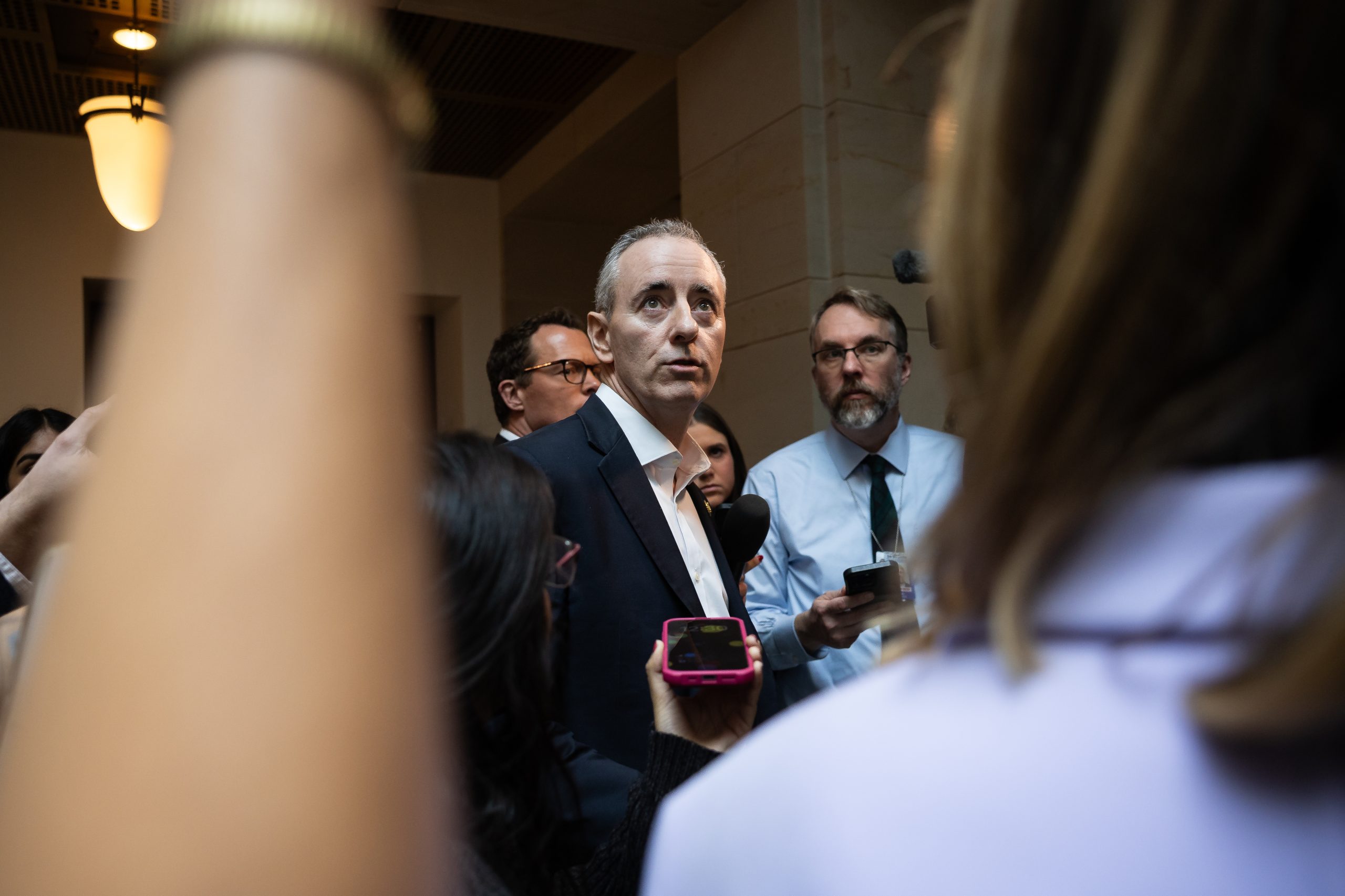
Brian Fitzpatrick, the five-term House Republican and perennial campaign target for Democrats, has long been viewed by GOP leaders as a team player. Until now.
On Wednesday, his 52nd birthday, the congenial Pennsylvanian led a GOP mutiny against Speaker Mike Johnson over his handling of expiring Obamacare subsidies used by more than 20 million Americans. Fitzpatrick became the first Republican to back a Democratic-led effort to sidestep the speaker and force action on an extension of the tax credits. Three fellow GOP moderates quickly followed, cementing a January vote.
Fitzpatrick, who has consistently won re-election in one of the most competitive districts in the country, said in an interview the rebellion should have come as no surprise to Johnson.
“I’ve made it clear where this was all headed,” he said Wednesday. “This was never a secret.”
But it stunned many who have watched Fitzpatrick maneuver over the past decade, staking out an aisle-crossing persona while also being careful not to impede leadership prerogatives. He voted at several key junctures to advance the GOP’s party-line megabill this year, for instance, while eventually voting against its final passage.
Now he is earning some begrudging praise from Democrats for, they say, finally walking the bipartisan walk instead of just talking the talk.
“It was politically the smart thing for him to do in such a challenging district, but it also is a courageous thing, and I want to acknowledge that,” said Rep. Greg Stanton (D-Ariz.).
Fitzpatrick’s decision to embrace a discharge petition filed by House Minority Leader Hakeem Jeffries has infuriated allies of Johnson, however, who argue that he is merely scrambling for political cover after moving too late to prevent a Dec. 31 lapse in the subsidies.
Rep. Ralph Norman (R-S.C.), a House Rules Committee member, blasted the “horrible” move from Fitzpatrick and allies and said he would try to kill the effort in the panel.
“I’ll do everything I can to block it,” he said.
Wednesday morning’s drama was the culmination of weeks of mostly behind-the-scenes wrangling between a small group of moderate House Republicans and party leaders, who knew that there was a limited appetite in the GOP ranks for any sort of extension for the Obamacare subsidies.
As co-chair of the centrist Problem Solvers Caucus, Fitzpatrick was at the middle of those contentious dealings as he sought to build support for a two-year extension of the subsidies that would also include new eligibility restrictions and anti-fraud guardrails. But the effort was caught between Democratic leaders who wanted their members to unite behind a straight three-year extension and GOP leaders who wanted none at all.
Fitzpatrick last week filed a discharge petition for his two-year proposal, drawing a dozen GOP colleagues but limited buy-in from Democrats. Jeffries wanted his own discharge petition on a three-year bill — which already had 214 Democratic signatures — to remain the most viable option to force a House vote.
At the same time, Johnson was moving to assemble a much more limited response to the expiring subsidies — a bill that would tinker around the edges of the insurance markets but do nothing to extend the subsidies.
When a POLITICO reporter informed Fitzpatrick last week that his GOP leadership was working on a health care framework that would not include a subsidy extension, he accused GOP leaders of living in a “fantasyland” and suggested Republicans would be hurting their own constituents for ideological reasons.
“These are people that we care about — these are our friends and neighbors that are receiving these subsidies,” Fitzpatrick said. “This is a personal thing for me.”
In the days that followed, a group of moderates that included Fitzpatrick as well as Reps. Jen Kiggans (R-Va.), Kevin Kiley (R-Calif.), Mike Lawler (R-N.Y.), Nick LaLota (R-N.Y.) and others sought to cut a deal that would allow some sort of a House vote on a subsidy extension.
GOP leaders, Fitzpatrick said, denied their requests to take one of their compromise measures directly to the floor. They were encouraged to file an amendment to the Johnson-backed health bill with the Rules Committee, but making their measures comply with GOP conference requirements became “unnecessarily complicated,” he said, as they forged ahead.
Johnson’s allies counter that Fitzpatrick and the GOP moderates weren’t completely united and simply couldn’t deliver on the basic criteria Johnson laid out to strike a deal for an amendment. The speaker himself told reporters Tuesday, “I thought there was an agreement on the Fitzpatrick amendment and then they made different decisions.”
Ultimately, late Tuesday night, the Rules Committee voted to send a bill to the floor with no amendments.
“So that’s what led us to today,” Fitzpatrick said Wednesday.
There is one silver lining for Johnson: Fitzpatrick went back to playing team ball soon after signing the Democratic discharge petition and voted to send Johnson’s health bill to the floor. He went on to vote to pass it: “I’m not going to vote against something out of spite.”
Fitzpatrick’s careful political balancing act will get a serious test this year as Democrats redouble their efforts to oust him from his swingy Bucks County district. He won his last race in 2024 by more than a dozen percentage points even as former Vice President Kamala Harris carried his district.
“I think it demonstrates how much danger they’re in politically by siding with the MAGA majority, which was just throwing caution to the winds in terms of people’s health care,” said Rep. Jamie Raskin (D-Md.). ”These are the desperate members of the Republican majority who are trying to hang on to their seats, and good for them that they understand what America wants.”
As Johnson was swarmed by reporters Wednesday morning asking about Fitzpatrick and the discharge petition, he said, “I have not lost control of the House.”
Fitzpatrick was a close ally of former Speaker Kevin McCarthy and is not seen as being especially close to Johnson. He could engage in additional freelancing in the coming year that would make governing the tiny Republican majority even more difficult for top party leaders.
In addition to the five discharge petitions he’s already signed this year, he is working with Rep. Gregory Meeks (D-N.Y.) to introduce another, on Russian sanctions.
“Every time somebody says that’s a tool of the minority, I correct them — it’s a tool of the rank-and-file,” Fitzpatrick said earlier this month. “To weaken the discharge would be just to empower the [party leaders], and we need more rank-and-file empowerment.”