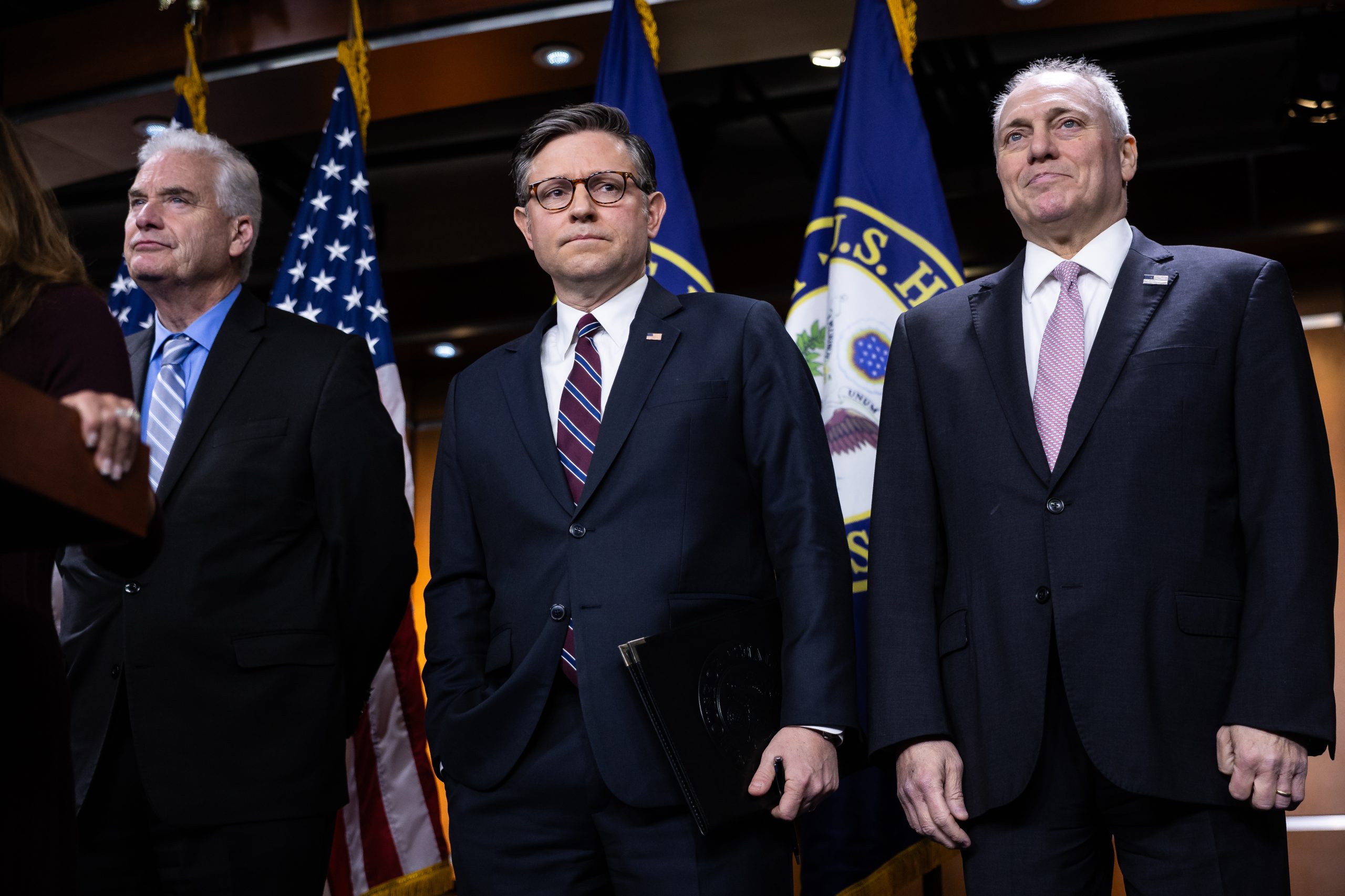
Frustrations are growing among House Republicans as their majority dwindles and agenda sputters — and it’s not just Speaker Mike Johnson who is feeling the heat.
Members were aghast after a stunning Tuesday night meltdown on the House floor, where opposition from a handful of GOP members led to the defeat of one labor bill and the postponement of three others. Some questioned why the Republican floor and whip teams — under the direction of Majority Leader Steve Scalise and Majority Whip Tom Emmer, respectively — had allowed the votes to be scheduled.
Rep. Brian Fitzpatrick (R-Pa.) was among the members who voted no Tuesday. He said he told leaders about his opposition and questioned why they are “bringing bills to the floor they don’t have the votes for, other than to think that they’re going to strong-arm people.”
“I think it’s really a question for them as to where they’re getting their math,” he added.
The rising concerns about the GOP whip operation come as the party struggles to hang onto its razor-thin voting majority. Since the beginning of the year, Georgia Rep. Marjorie Taylor Greene resigned, Rep. Doug LaMalfa of California suddenly died and a spate of medical-related absences and family emergencies have plagued the party.
The GOP currently has a 218-213 majority if all members are present and voting — which day-to-day is a huge “if.”
Leaving the floor after the failed vote Tuesday night, Johnson insisted, “We’re totally in control of the House.”
Asked in an interview if GOP leaders have a whipping problem, Scalise said, “We ultimately have a vote count problem with the limited number of members.”
“You have absences, you have other things — I mean, we just had a member pass away,” he added. “It’s going to be a tough road, but we’re going to keep moving our agenda.”
Still, the Tuesday episode led to a significant waste of precious floor time for House Republicans as they try to convince voters they’re working to address cost-of-living issues ahead of the midterms and Johnson continues to insist on pursuing a party-line policy bill this year — a follow-up to last year’s tax-cuts-focused GOP megabill.
Top leaders did see some success last year eking out tough votes, calling the question and then cajoling and cutting deals with holdouts before bringing the gavel down. One procedural vote for the GOP megabill last year was held open for more than nine hours while leaders and White House officials negotiated a deal securing the legislation’s passage.
“I have a magic power of being able to whip everybody at the end, and it usually works,” Johnson told reporters Wednesday.
But that didn’t happen Tuesday, when leaders had to give up on a bill that would rewrite wage rules so employers would not have to pay overtime rates for training in some cases. Pro-labor GOP Reps. Fitzpatrick, Rob Bresnahan (Pa.), Nick LaLota (N.Y.), Jeff Van Drew (N.J.), Chris Smith (N.J.) and Riley Moore (W.Va.) all voted against the legislation.
Rep. Pete Sessions (R-Texas), a former Rules Committee chair, largely reserved judgment about the floor chaos. But he did note that “in the past, we focused on an entirely different process than I believe is done today.”
Other GOP members granted anonymity to speak candidly about the episode were less restrained.
“They didn’t even whip the fucking bill,” one House Republican said. “It was unbelievably dumb and unbelievably reckless,” said another.
Members of the whip team led by Emmer checked in with key Republicans during House votes the night before about how they planned to vote on the labor bill. They heard concerns from some members, but not many hard “nos,” according to three people granted anonymity to describe the internal process. A spokesperson for Emmer did not respond to a request for comment.
“I let them know,” Moore said. “We need to be standing up for the American worker, not making it more difficult.”
Van Drew said he didn’t decide to vote against the bill until the day of the vote and did not inform leaders in advance, but he also said they never asked about his view on it.
“Our majority is so tight — it’s a problem,” he said. “They should have whipped it, No. 1. And then secondly, my bad. I should have let them know, even if it was only a half-hour before.”
The heads-up likely wouldn’t have made a difference. Other Republicans directly warned Emmer and Scalise of the labor problem, according to four people granted anonymity to describe private conversations about the legislation.
Scalise said in the interview that when a bill is unanimously approved by Republicans on a committee — as was the case for the overtime bill — “then we’re going to make our best effort to get it passed.”
“You don’t want days like yesterday,” he said. “But … on the bills that are the top priorities of our agenda, which we make very clear well in advance, we’re moving those bills. We have moved them, and we’ve got a lot more we’re going to be bringing this year, and we will pass those bills.”
In other words, Scalise gave no indication GOP leaders plan to abandon their get-close-and-roll-the-dice approach in 2026.
On Tuesday, Johnson’s leadership team knew there would be some GOP absences, and at least some idea of the intraparty opposition, according to four other people with direct knowledge of the matter, but they believed they could wrangle enough votes to pass the scheduled bills.
Among the Republicans leaders tried to work over was Smith — one of the longest-serving members of the House and one who has long held pro-labor positions. Smith held his ground, saying he had made commitments to people in his district and he was not going to vote for the legislation, according to three people who heard the conversation.
Johnson told reporters Wednesday Smith was among a group of members “that didn’t let us know in advance, and it was nobody’s mistake.”
“He was with his wife in an oncology appointment all morning, so he wasn’t here to inform us,” he said. “But not a big deal, just part of the process.”
The episode underscored how GOP leaders are effectively unable to move pro-business and anti-union labor legislation, a key plank of the party agenda. The slim majority allowed the small band of pro-labor Republicans to corner Johnson late last year, signing a Democratic-led discharge petition forcing a vote on a bill protecting federal worker unions.
Democrats are eager to push other discharge petitions on labor matters in the wake of the recess successes, while the GOP is unlikely to bring the issue to the floor themselves.
“I don’t think you’re going to see another labor bill on the floor this year,” another House Republican said.
Nicholas Wu contributed to this report.