Congress is on a path toward a partial government shutdown next week after Senate Democrats vowed to oppose Department of Homeland Security funding following the killing of a 37-year-old Minneapolis resident by federal agents Saturday.
Senate Minority Leader Chuck Schumer said in a statement Saturday night that Democrats would not help advance the six-bill spending package set for consideration next week as long as it includes DHS funding. Republicans will need Democratic support in order to clear a 60-vote hurdle to advance the funding bill.
“Senate Democrats will not provide the votes to proceed to the appropriations bill if the DHS funding bill is included,” Schumer said, adding that he would personally vote “no.”
Congress has already passed full-year funding for some agencies — including the departments of Agriculture, Commerce, Interior and Justice — but not for several of the largest, including the Pentagon. Temporary funding for those departments, representing more than 75 percent of federal discretionary spending, expires midnight Friday.
Senate Democrats will hold a conference call Sunday evening, according to a Democratic aide granted anonymity to discuss the private meeting. The call will give them a chance to discuss next steps with the Senate stuck out of town until at least Tuesday because of the massive winter storm affecting much of the country.
Earlier in the day, as news of the Minneapolis shooting spread, several Democratic senators who had previously voted to advance government funding measures under President Donald Trump vowed to oppose DHS funding this time. Funding for ICE and Border Patrol, the agencies involved in the Minnesota operation, is included in the pending Senate bill.
“I am voting against any funding for DHS until and unless more controls are put in place to hold ICE accountable,” said Sen. Brian Schatz (D-Hawaii) in a statement Saturday. “These repeated incidents of violence across the country are unlawful, needlessly escalatory, and making all of us less safe.”
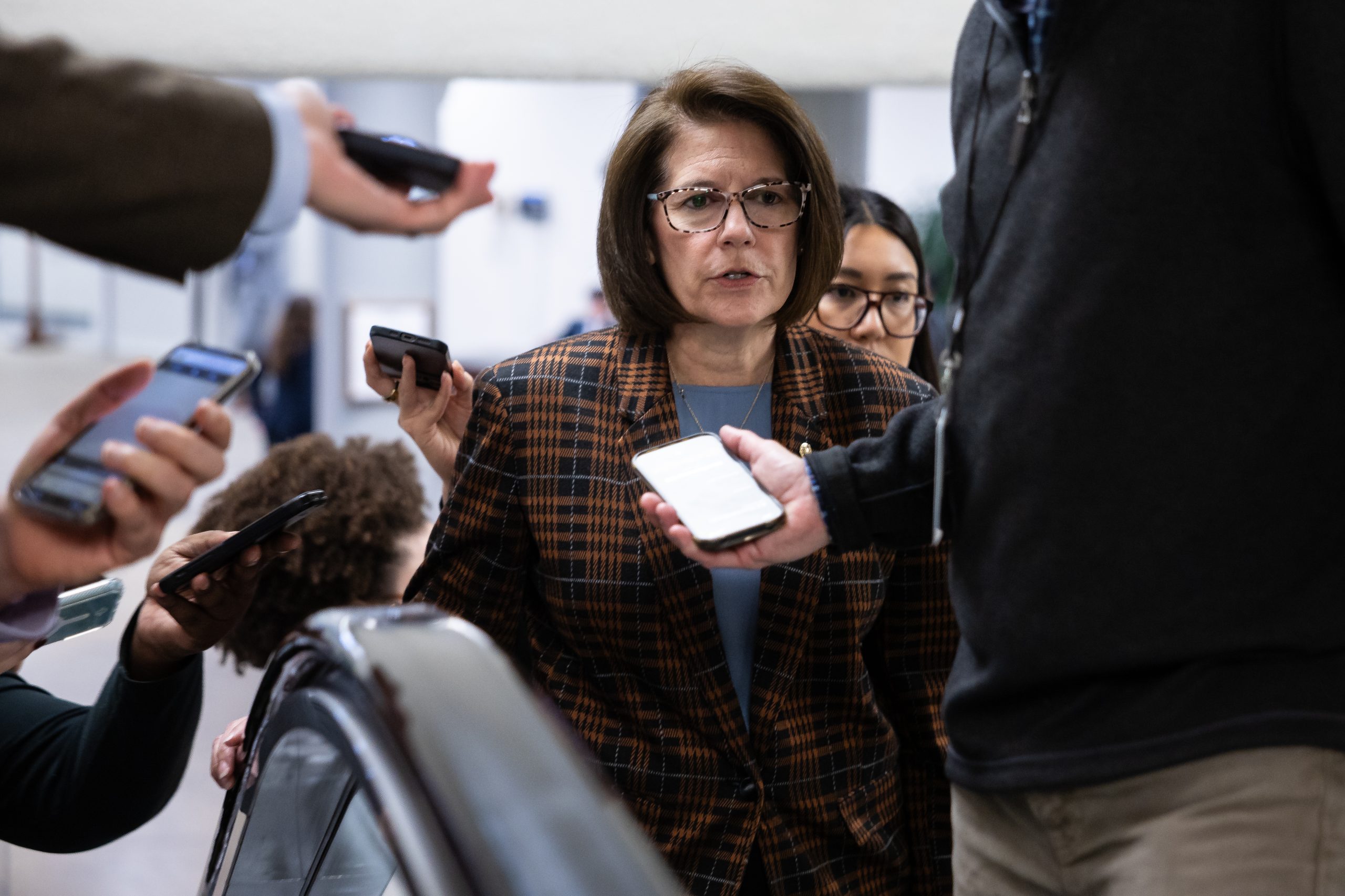
Schatz helped advance a funding bill in March, and Sens. Catherine Cortez Masto (D-Nev.) and Jacky Rosen (D-Nev.), who voted to end the 43-day shutdown in November, also both said Saturday that they will oppose the DHS funding bill.
“I have the responsibility to hold the Trump Administration accountable when I see abuses of power — like we are seeing from ICE right now,” Rosen said on X. “That is why I’ll be voting against any government funding package that contains the bill that funds this agency, until we have guardrails in place to curtail these abuses of power and ensure more accountability and transparency.”
The DHS bill passed the House Thursday 220-207, with only seven Democrats voting for it. But Republican House leaders merged it with five other bills funding the departments of Defense, Health and Human Services and State, among others, sending it to the Senate as one package.
More than half of the 47-member Democratic caucus has already vowed to oppose the package, many before Saturday’s shooting. And that number is growing as Democrats’ re-evaluate the legislation in the wake of the shooting and as they face pressure from House Democrats and their Senate colleagues, not to mention outside voices close to the party base.
Abdul El-Sayed, a Democratic candidate seeking a Senate seat in Michigan, said in an interview Saturday he saw no way for any Democrat to justify a vote for DHS funding.
“How many more people do they need to shoot?” he asked.
A group of senators, including Chris Murphy (D-Conn.) and Alex Padilla (D-Calif.), have been whipping colleagues for days to oppose the DHS bill, according to two aides granted anonymity to discuss their private effort. And two people familiar with the plans said House Democrats are scheduled to hold a private caucus call Sunday morning to discuss a response to the shooting.
Cortez Masto, in a statement, suggested dropping the Department of Homeland Security bill from the larger package, noting there is a “bipartisan agreement on 96% of the budget.”
“Let’s pass the remaining five bipartisan bills and fund essential agencies while we continue to fight for a Department of Homeland Security that respects Americans’ constitutional rights and preserves federal law enforcement’s essential role to keep us safe,” she said.
Sen. Jack Reed (D-R.I.) said he would agree to “immediately pass” the other five bills while providing “short term funding for DHS so the Senate can fully debate and vote on common sense reforms to ICE that bolster the rule of law.”
But stripping out the DHS bill before the Friday deadline would require every senator to agree — something Republicans aren’t likely to be able to get. Any changes to the package, meanwhile, will require sending it back to the House, which has already left town until after the shutdown deadline.
Instead, Republicans believe it’s up to Democrats to decide whether or not to vote against the funding package and avoid a partial shutdown. GOP leaders aren’t currently expected to bring the House back early from its break, according to three people granted anonymity to discuss internal strategy.
Democratic aides, meanwhile, privately acknowledged Saturday that the odds of a shutdown were rising, though some questioned what alternatives are available if Democrats block the pending six-bill package.
Heading into the weekend, some Democrats acknowledged they were conflicted — including Sen. Chris Coons (D-Del.), a senior appropriator who has championed Congress’ ability to use the spending bills to reverse many of Trump’s foreign aid cuts.
“I don’t know the details of exactly what the language is in the Homeland Security bills in terms of trying to hold ICE accountable and trying to minimize their misconduct, and I don’t know whether it is worse to have a continuing resolution and how that might be misused,” Coons told reporters Friday.
Adam Wren, Meredith Lee Hill and Jennifer Scholtes contributed to this report.