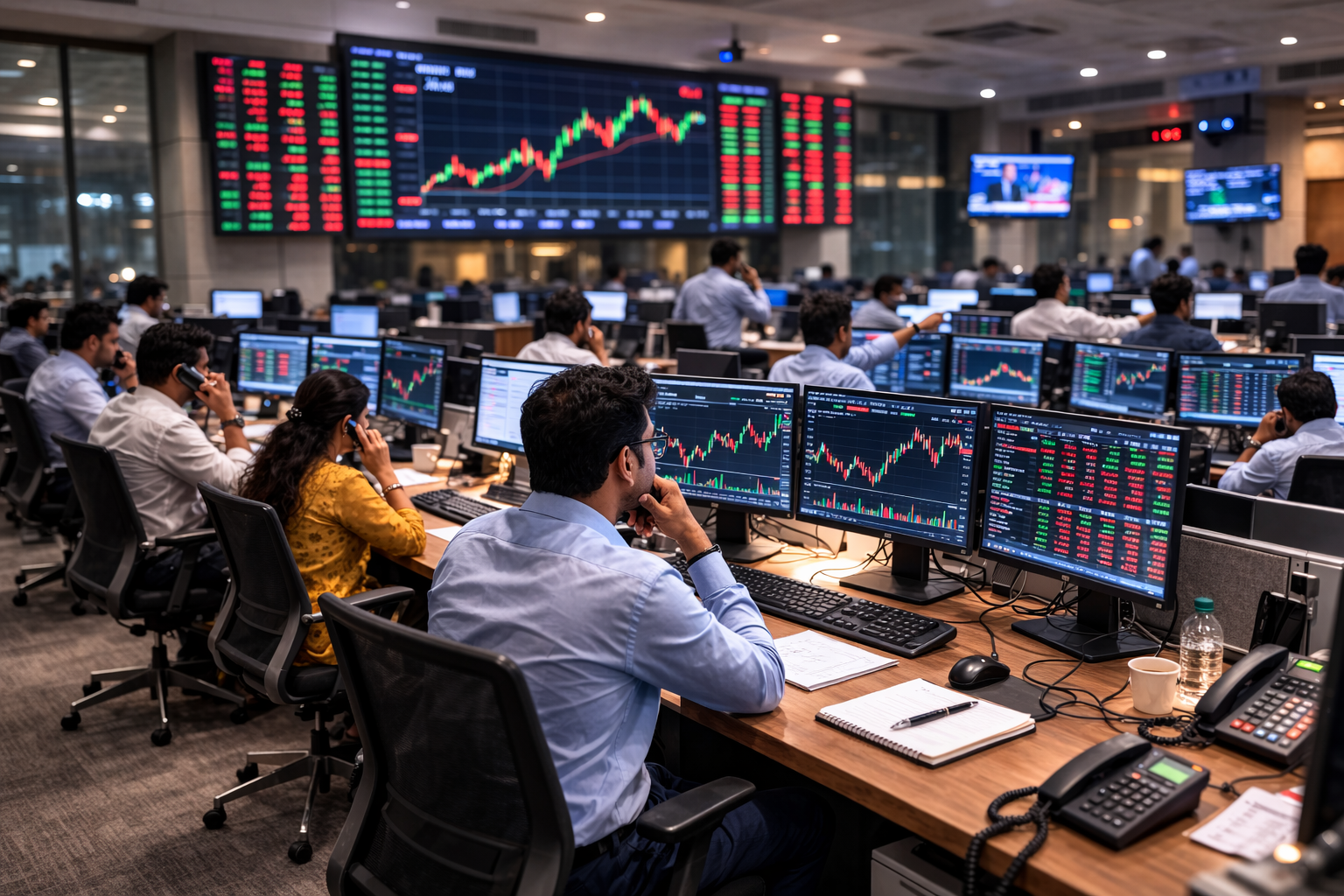
On Monday, Equity markets in Asia showed uneven reactions to renewed US tariff actions, European officials pressed Washington for clarity after a court ruling on trade policy, negotiations between the United States and Iran continued amid military tensions, and cryptocurrencies weakened as risk aversion rose.
Asian markets rise after tariff ruling
Asia-Pacific markets gained after US President Donald Trump announced plans to increase global tariffs to 15% from 10% over the weekend.
The move followed a US Supreme Court decision striking down a large portion of the president’s trade agenda enacted under the International Emergency Economic Powers Act of 1977.
Regional equity markets reacted unevenly. Hong Kong’s Hang Seng Index jumped more than 2.3%, while South Korea’s Kospi advanced for a third consecutive session, rising 1.7% to a record high as SK Hynix and Samsung Electronics gained.
Althoughat the time of writing, the index was trading at 0.31%.
Australia’s S&P/ASX 200 was down 0.61%, and India’s Nifty 50 was up by 0.34%.
The markets in Japan and mainland China were closed for holidays.
Oil prices weakened later in trading, with Brent crude down 1.05% to $69.92 a barrel and US West Texas Intermediate futures falling 1.14% to $65.72.
European Union presses US to uphold trade pact
The European Commission urged the United States to honor last year’s trade agreement and provide clarity on its next steps.
“The current situation is not conducive to delivering ‘fair, balanced, and mutually beneficial’ transatlantic trade and investment, as agreed to by both sides,” the Commission said. “A deal is a deal.”
The EU noted that unpredictable tariff policies risk undermining business confidence and global trade stability.
The trade arrangement previously capped tariffs at 15% for most European goods and included zero tariffs for some products such as aircraft and spare parts.
EU Trade Commissioner Maros Sefcovic discussed the issue with US Trade Representative Jamieson Greer and Commerce Secretary Howard Lutnick as both sides sought to prevent escalation.
US–Iran nuclear talks continue amid rising military pressure
Diplomatic negotiations between Washington and Tehran continued as the United States increased its military presence in the Middle East.
Iran signaled a willingness to offer concessions on its nuclear program to avoid potential military action and secure sanctions relief.
An Iranian official said Tehran could send part of its enriched uranium abroad, dilute the remainder, and participate in a regional enrichment consortium in exchange for recognition of its right to peaceful enrichment and removal of sanctions.
The official said the countries remain divided but discussions are ongoing and “the possibility of reaching an interim agreement exists.”
Iranian Foreign Minister Abbas Araqchi also indicated optimism, saying there is still “a good chance” of a diplomatic solution.
US envoy Steve Witkoff questioned Iran’s position, asking why Tehran had not agreed to restrictions despite pressure.
The talks come as Washington considers possible strikes, while Iran warned it could target U.S. bases if attacked.
Bitcoin declines amid risk-off sentiment
Cryptocurrency markets weakened sharply alongside rising global uncertainty.
Bitcoin fell more than 3.9% to below $65,000 on Monday after the tariff announcement, extending a longer downturn from levels above $125,000 in October.
Ether declined nearly 5% to around $1,874.
The drop accelerated when bitcoin slid from about $67,600 to roughly $64,700 within two hours, triggering about $360 million in long liquidations.
Gold, by contrast, rose about 1.9%, highlighting divergence between bitcoin and traditional safe-haven assets.
The post Morning brief: Asia markets rise, Bitcoin drops below $65K appeared first on Invezz