

The ongoing LPG crisis in India, triggered by the Iran war, has exposed the country’s deep dependence on fuel imports.
“This is a wake-up call,” Alok Kumar, former power secretary in the Union Ministry of Power, India, and current DG of All India Discoms Association, told Invezz.
“It’s good that we discuss this and the government takes it up as a mission, not only because the government dependence (on imports) should decrease, but also because the entire energy transition is premised on the electrification of energy services.”
“You cannot achieve net zero without electrification, and so it serves the cause of long-term emission reduction as well,” he added.
India has launched several awareness campaigns and policies, including the ‘Go Electric’ campaign started in 2021 to promote the use of electric vehicles and household appliances such as induction cooktops and electric pressure cookers.
However, experts note that the efforts have yet to reach the scale needed to make a meaningful impact.
How the Iran war exposed India’s acute LPG import dependence
India’s reliance on imports of liquefied petroleum gas (LPG) has intensified in recent decades.
Currently, external sources meet as much as 60% of the country’s LPG needs, with the country spending roughly $26.4 billion annually on LPG imports.
Out of this, 90% of the imports move through the Strait of Hormuz, the critical passage for 20% of global crude supplies, which is facing a blockade and severe disruption due to the ongoing conflict.
According to the country’s ministry of shipping, 1.67 million tonnes of crude oil, 320,000 metric tonnes of LPG and about 200,000 tonnes of LNG are stuck on the 22 Indian-flagged ships stranded in the Persian Gulf, waiting to transit through the Strait.
Meanwhile, the crisis has hit home hard with restaurants and eateries struggling to procure cylinders, being forced to cut down on offerings, and taking big hits to their business.
At the peak of the crisis last week, some restaurants had to shut down temporarily as well as LPG stocks ran out.
Meanwhile, household consumers were seen queueing up outside gas agencies across the country, even as induction cookers flew off the shelves.
The Indian government on Wednesday noted that the situation of Liquefied Petroleum Gas (LPG) is still worrisome and offered an additional 10% allocation of commercial LPG to States and Union Territories (UTs).
State of adoption of e-cooking in India and factors limiting its use
As per the Indian Residential Energy Survey (IRES) conducted in 2020, electricity use for cooking remains marginal in Indian homes, with only 5% of households using any electric cooking appliance.
As expected, the use of e-cooking is higher in urban India (10%) than in rural areas (3%).
Since e-cooking is not very affordable either, adoption rates were also six times higher among the top five wealth deciles than the bottom five.
Also, studies have found that even in houses that have adopted e-cooking, the primary fuel, either LPG or LNG, has not been replaced, but only complemented.
“Electric cooking is far more dispersed and hence more difficult work because it needs a lot of behavioural change,” says Kumar.
There are many factors that prevent the widespread use of electric cooking.
These include high upfront appliance costs, cooking habit adaptation, reliable electricity supply concerns, and gaps in repair and maintenance services.
The average price of a single-burner induction stove in India typically ranges from ₹1,500 to ₹3,000.
Premium/high power (2000W+) models range from ₹2,500 to ₹4,000 or more, offering faster cooking and advanced features.
Along with the purchase of an induction stove, a household also has to invest in utensils that are compatible with induction cooktops.
Purva Jain, lead energy specialist, gas & international advocacy, South Asia, at the Institute for Energy Economics and Financial Analysis, however, points out that there does exist a market gap when it comes to induction cooking in terms of both pricing and design.
Studies show e-cooking is more affordable than LPG/PNG
Even so, studies have held that e-cooking over the long term is more affordable than LPG or LNG.
According to the International Institute for Sustainable Development, in urban and peri-urban areas, electric cooking is becoming an increasingly competitive option.
At current prices, annual cooking costs are estimated at INR 6,800–6,900 for LPG or PNG, compared to INR 5,800–5,900 for electric cooking.
This cost advantage persists even with a moderate increase in electricity tariffs.
Source: CSE
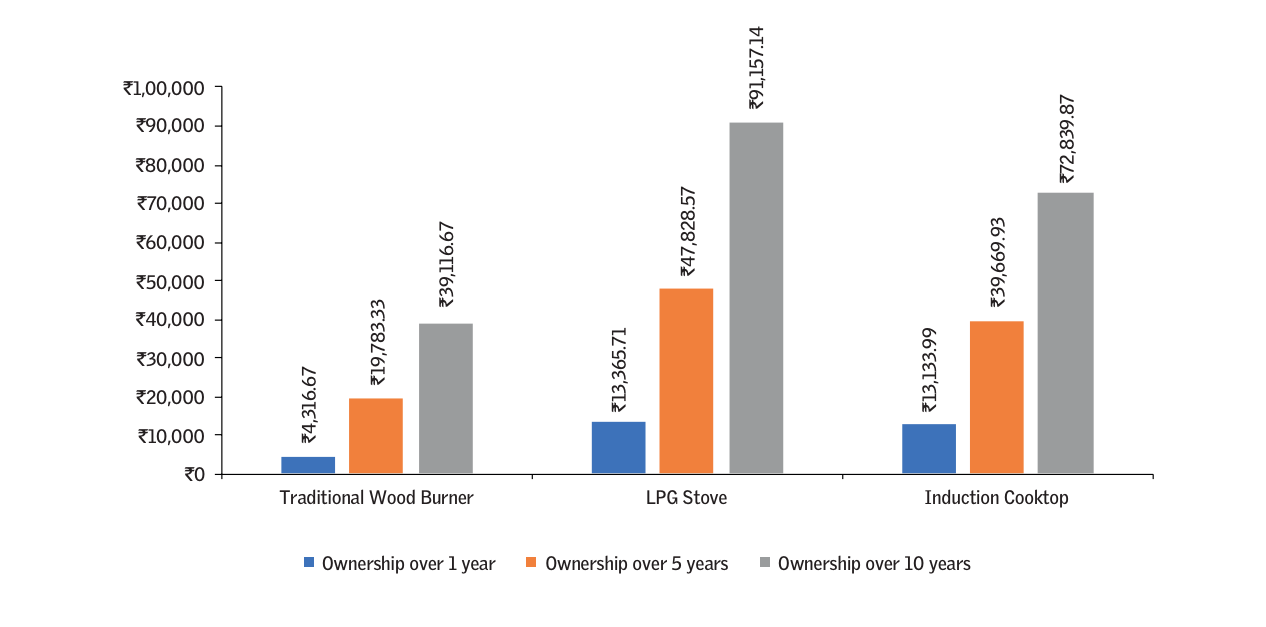
Further, a study by the Centre for Science and Environment (CSE) in 2023 found that over the course of five and ten years, the cost of ownership of cooking with electricity was about 20% lower than with LPG, but was comparable over the first year.
“Costs drop significantly as usage continues over time, and e-cooking becomes 17% cheaper than LPG over five years, and over 20% in 10 years. However, it must be kept in mind that these projections have not factored in rising gas prices or inflation,” the study said.
Impact on grid and possible ways to tackle it
One of the most crucial factors to consider is that increased demand for electricity from e-cooking can strain existing grid capacity, which means that even if households and other commercial users might be willing to adopt this mode of cooking in a big way, infrastructure upgrades will be required to support the additional load.
“From the distribution network aspect, the difficulty is that peaking load will go up. E-cooking does not envisage battery storage because it is not very economical to store solar energy and then use it for e-cooking,” Kumar says.
Kumar says to tackle this, some demand in peak hours can be shifted to non-solar hours through tariff incentives, to make space for electric cooking in the evening, when it will also compete with air conditioning.
“We will have to, in parallel, take steps for more demand-side management like demand flexibility, shifting some load from non-solar to solar. Because India will be a very solar-heavy system, and if you do not shift the demand, then the battery storage will become very expensive,” he says.
Why electric options are better for India’s energy security?
While households and some commercial establishments have quickly ensured they have an induction cooktop ready in the current crisis, the Indian government is encouraging both households and commercial users to shift to PNG (piped natural gas) instead.
The Centre announced it will raise commercial LPG allocation from 20% to 30% for states that commit to reforms boosting PNG penetration.
It is now encouraging wider adoption of PNG, particularly in urban areas where infrastructure is available.
About half of India’s PNG supply is domestic gas drilled from onshore and offshore fields, for example, by companies such as ONGC and Reliance.
The balance is met through LNG imports.
Imports totalled around 24–25 million tonnes in 2025, making India one of the world’s largest LNG buyers.
The conflict has not spared India’s gas imports either, with the blockade in the Strait of Hormuz already disrupting supplies.
However, the situation has worsened following Iran’s strike on Qatar’s energy infrastructure at Ras Laffan industrial city, hours after Israel targeted Iran’s South Pars gas field—the world’s largest natural gas reserve.
India sources roughly 20% of its natural gas imports from Qatar, heightening concerns over supply risks.
Jain says transitioning to gas would not be the best way to solve the issue of energy security.
“LPG and LNG, at least going by what we have seen in the past five years, have always been very volatile,” Jain tells Invezz, adding that gas has been volatile even before Covid-19.
According to an analysis she says they did two years ago, where they looked at different commodities like gold, NASDAQ, oil as well as gas, in the one-year time span of 2024, gas was the most volatile.
“In events of general geopolitical calm, too, gas was volatile—that is the nature of that fuel,” she says.
“Therefore, transitioning from LPG to gas would probably not help us solve the problems of energy security, subsidies, affordability, etc. But transitioning to electric could, as it is more affordable, more energy efficient, and actually gives us the energy security,” she said.
Lessons from India’s EV transition
According to Jain, EV adoption in India has seen success due to strong government policy, lower operational costs compared to conventional fuels, rising consumer awareness, and global campaigns and adoption.
A similar coming together of the right factors could also help position electric cooking (e-cooking) as a valid cooking fuel choice in India.
India’s electric vehicle (EV) market crossed a major milestone in 2025, with total EV sales reaching 2.3 million units, accounting for 8% of all new vehicle registrations, according to the Annual Report: India EV Market 2025 prepared by the India Energy Storage Alliance (IESA) based on Vahan Portal data.
However, it is still way behind the Indian government’s target for EVs to make up 30% of total passenger vehicle sales by FY 2030.
“India has managed to do very well on the front of EV adoption, I would say. In a span of less than a decade, we have managed to see good numbers, which is a big achievement,” Jain says, attributing the progress to clear policy direction such as demand and supply-side incentives and awareness programs.
In this context, the Faster Adoption and Manufacturing of (Hybrid &) Electric Vehicles in India (FAME India) scheme launched in 2015, and concluded in 2024, played a major role as it was aimed at market creation and early adoption through infrastructure deployment, demand incentives and domestic manufacturing.
The FAME II program, which started in April 2019, focused on electrifying public and shared transportation.
“It happened because a collection of factors came together for it to happen and work. And this is something I have also talked about when I have compared the two, that electric cooking needs a collection of factors to sort of come together to make it work because it’s definitely an economically more viable solution,” she says.
In a study by Jain, published by the IEEFA, she recommends introducing a similar scheme to FAME, which could focus on market creation, such as demand incentives, and reducing upfront purchase costs for wider adoption.
“A policy promoting e-cooking in commercial spaces could also be beneficial, much like how state policies and the PM-eBus Sewa scheme were for electric buses,” the study says.
She adds that multiple awareness campaigns were run by the government that advocated the benefits of using EVs in India and helped address the initial transition challenges to some extent.
Such an understanding needs to be extended to e-cooking as well via public awareness and demonstration campaigns.
Actionable initiatives and the way forward
It is agreed upon by experts that the initial market to push e-cooking forward will be urban India, and within urban India, the start should be made with community kitchens and commercial spaces, as change at a household level is challenging.
“My view is that initially we should promote electric cooking in community kitchens, Anganwadis, and schools because it is also a bulk demand and it will make sense to make that investment,” says Kumar.
“Even restaurants can have dual cooking arrangements (of LPG/LNG and e-cooking) as the equipment is not very expensive. They can make use of electric cooking during solar hours in the day when the power is abundant, and we can make it cheaper for them, and in the evening, they can use a mix of sources,” he said.
Jain agrees and says mandates for commercial kitchens and anganwadis, government schools where mid-day meals are being provided, or even bigger institutions like hospitals, can be the first line of priority.
She also speaks of adopting certain international practices.
For example, in 2023, New York became the first state in the US to ban natural gas and other fossil fuels in most new buildings, with officials hoping it will encourage the use of more climate-friendly appliances, like induction stoves.
“The government could liaise with big developers and see that the first option that is being provided in new housing developments is electric cooking. Such mandates are likely to lead to massive uptake, and like we are seeing right now, if push comes to shove, the change will happen,” she says.
“And the best part is that in the longer term, you are looking at the greening of the grid, you are looking at higher deployment of renewable energy sources. We have those targets, and India is already working rapidly to deploy clean energy in the country,” she says.
Further, this is also an opportune time for companies manufacturing electric cooking appliances to invest in R&D and come up with more energy-efficient solutions, say experts.
After-sales services should also be strengthened, while local capacity should be augmented to ensure a smoother transition.
The post LPG crisis: can electric cooking shield India’s economy from supply shocks? appeared first on Invezz